

This story appears in the October 2026 issue of Around the Town
In 1967, a young man walked across the stage at Stephen F. Austin State University and received his Bachelor of Arts degree, marking the completion of years of hard work. But for him, making future plans seemed almost pointless. He knew a letter from Uncle Sam was coming. With the Vietnam War raging, he understood that his future was not entirely his to decide. That envelope arrived in October 1968. With it came the end of the waiting—and the beginning of a journey that he and his lovely wife, Sherry Jacobs Rulfs, had known was coming all along.
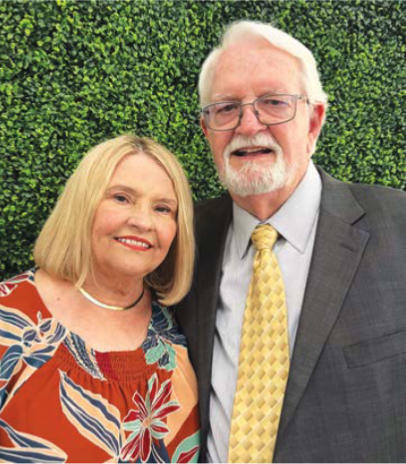
Pictured above are Sherry and John Rulfs
During his military entry testing, John demonstrated a unique aptitude for interpreting aerial photographs, a skill that caught the attention of both Air Force and Navy. Each encouraged him to pursue pilot training, but he declined the opportunity. The Navy then offered him an alternative path in its Supply Corps, where he could serve as a Disbursing and Food Service Officer. He was assigned to the USS La Salle.
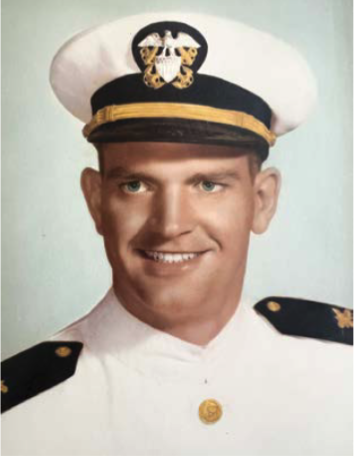
John Rulfs
The USS La Salle began as LPD-3, an amphibious transport dock for Marines and equipment. In 1972, she was redesignated AGF-3 and converted at Philadelphia Naval Shipyard into the flagship of the U.S. Middle East Force. Equipped with command centers, communications systems, staff offices, and senior-officer quarters, she became a floating headquarters and, painted white to reflect the sun, earned the nickname “Great White Ghost of the Arabian Coast.”
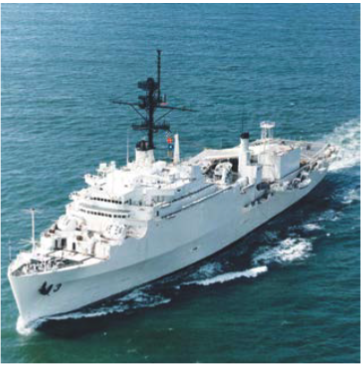
The USS La Salle
As Disbursing and Food Service Officer on this enormous ship, John managed two essential responsibilities: military pay and feeding the crew. The role required careful financial accountability, along with overseeing food purchasing, inventory, preparation, sanitation, and personnel. For a young officer, it provided valuable experience in the administrative and logistical side of military life. When the USS La Salle entered a port of call, the work of the Disbursing Officer often took him ashore. He would carry Treasury bills and other authorized financial instruments to a local bank, where they could be exchanged for several hundred thousand dollars needed to pay the crew. It was a task that required absolute trust and careful attention to detail. Once the local bank had converted the Treasury bills into cash, the Disbursing Officer faced the most sensitive part of his assignment—getting the money safely back to the ship. He made the return trip in an old white Chrysler, an intentionally unremarkable vehicle that helped him blend into traffic while carrying the Navy’s money.
The USS La Salle took good care of its crew, serving four meals a day, with hot dogs and hamburgers among the favorites. Hoping to surprise the sailors, Officer Rulfs ordered 600 pounds of lobster. But most had never eaten it and showed little interest. It was a humorous reminder that even the finest meal isn’t always the one a sailor wants on his tray.
One of the USS La Salle’s proudest accomplishments was receiving the Captain Edward F. Ney Memorial Award for excellence in Navy food service. Established in 1958, the Ney Award recognized outstanding performance in food quality, sanitation, inventory, organization, safety, training, and management. As Disbursing and Food Service Officer, John played a key role in the operation, making the award a reflection of both the food-service crew’s hard work and his leadership and attention to detail.
Toward the end of John’s tour in 1972, the USS La Salle departed the United States for Bahrain as part of the African and Middle East Cruise. During the voyage, the ship crossed the equator, giving first-time sailors, known as “pollywogs,” the chance to participate in the Navy’s traditional “Crossing the Line” ceremony. Following the good-natured initiation, they were officially recognized as “shellbacks.”
After returning to civilian life, John and Sherry began a new chapter. John joined Stephen F. Austin State University as Assistant Director of Purchasing, where his logistics and administrative experience quickly proved valuable. After five years, he advanced to Assistant Director and later Director of Physical Plant and Construction, overseeing the university’s facilities, construction, and infrastructure.
John, thank you for your important service during the Vietnam era. You answered the call when your country needed you and served honorably. We are grateful for the time and commitment you gave to our country. May God bless you.