

What Started as a Forensic Science Degree Turned into a Much Bigger Education
Link to story received from media relations for Texas A&M AgriLife – Email: news@ag.tamu.edu
Author of the article below is Mamie Hertel
Story comes from AgriLife Today – Texas A&M AgriLife’s Digital Magazine and Newsroom
Boluwasefe Adelugba ’26 knew her career path from an early age. She was 12 when she wrote “forensic pathologist” in a notebook, and she meant it.
Years of crime dramas like “Criminal Minds” and “The Rookie” led her to seek out the best forensic science programs in the country by her freshman year of high school. Texas A&M University topped the list, and she committed at 17, sight unseen, drawn by Southern culture, a college town steeped in tradition and Southeastern Conference football.
Adelugba, who goes by Bolu, was certain about nearly everything that led her to Texas A&M. Her name, Boluwasefe, means “God wanted” in Yoruba, and she said it is the thing she likes most about herself.
“It reminds me that anything I want in this world, I’m capable of achieving,” Adelugba said.
What she did not expect was which college at Texas A&M that major would actually belong to, or how much bigger her definition of agriculture would eventually become. But that belief carried her through her major and her college choice, guided by an instinct to trust a decision before she could fully explain it.
Today, as a peer recruiter for the Texas A&M University Office of Admissions, Adelugba passes that instinct on to prospective students, telling them what her own path already proved true: that a degree, and a college, can end up being much bigger than what first drew you to it.
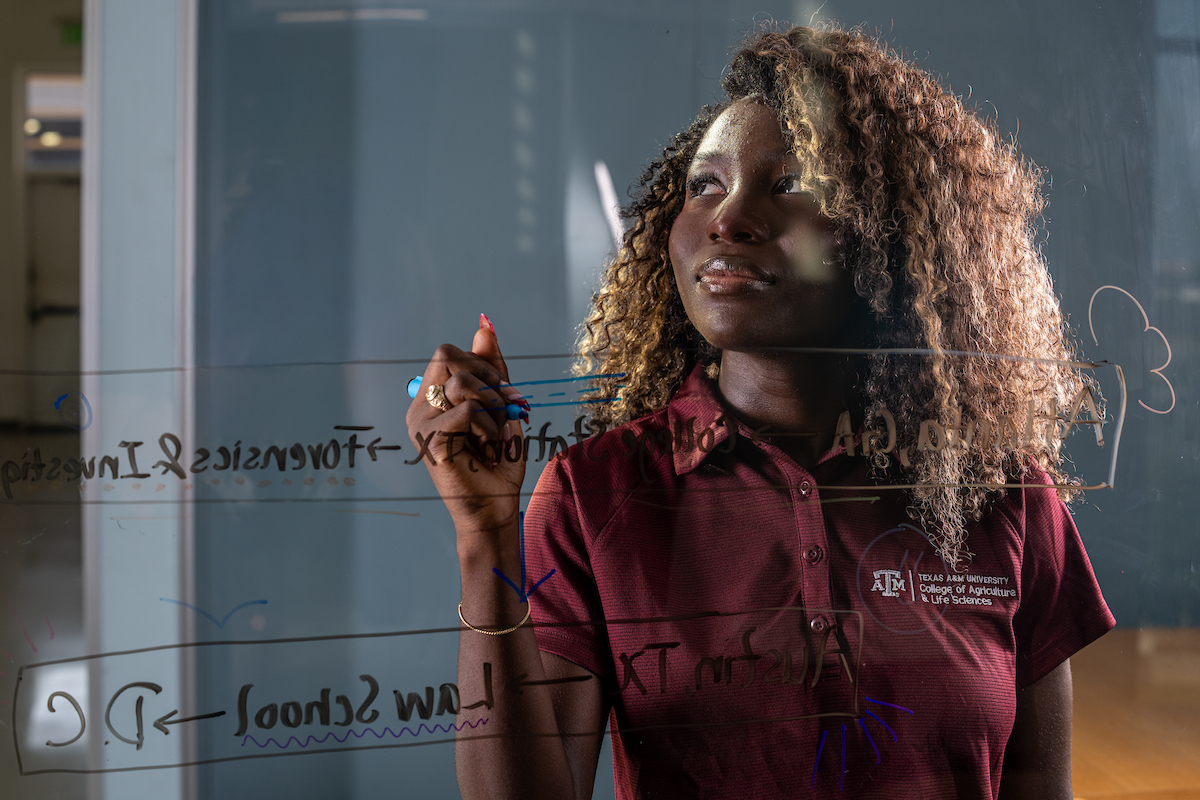
Boluwasefe Adelugba ’26 maps her path from Atlanta to Texas A&M and on toward law school and Washington, D.C. A forensic science major in the College of Agriculture and Life Sciences, she has learned to trust a direction before she can fully explain it. (Hannah Lang/TX A&M AgriLife)
Forensic Science’s Home in an Unlikely Department
Ask most people where forensic science lives at Texas A&M, and not many would guess the Department of Entomology, tucked inside the College of Agriculture and Life Sciences.
Adelugba did not know it either until her first class in the Kleberg Animal and Food Sciences Center, surrounded by decor that had nothing to do with crime labs.
“I walked in and thought, there’s a lot of animal things on the wall,” Adelugba said with a laugh.
Her forensic science degree plan itself turned out to be just as unexpected. It includes 36 hours of directed electives, meaning that more than a third of her coursework is hers to design. That flexibility let her layer a pre-law track onto a science-heavy major most future lawyers would never touch.
“Everyone questioned my studies in forensic science and my decision to go to law school,” Adelugba said. “But I wanted a rigorous degree that would prepare me for my future.”
An internship at the Brazos County District Attorney’s Office added another piece she had not planned: She loved the science, but the courtroom was not where she wanted to spend her career. Forensic science, it turned out, had already been quietly pointing her toward something outside a crime lab.
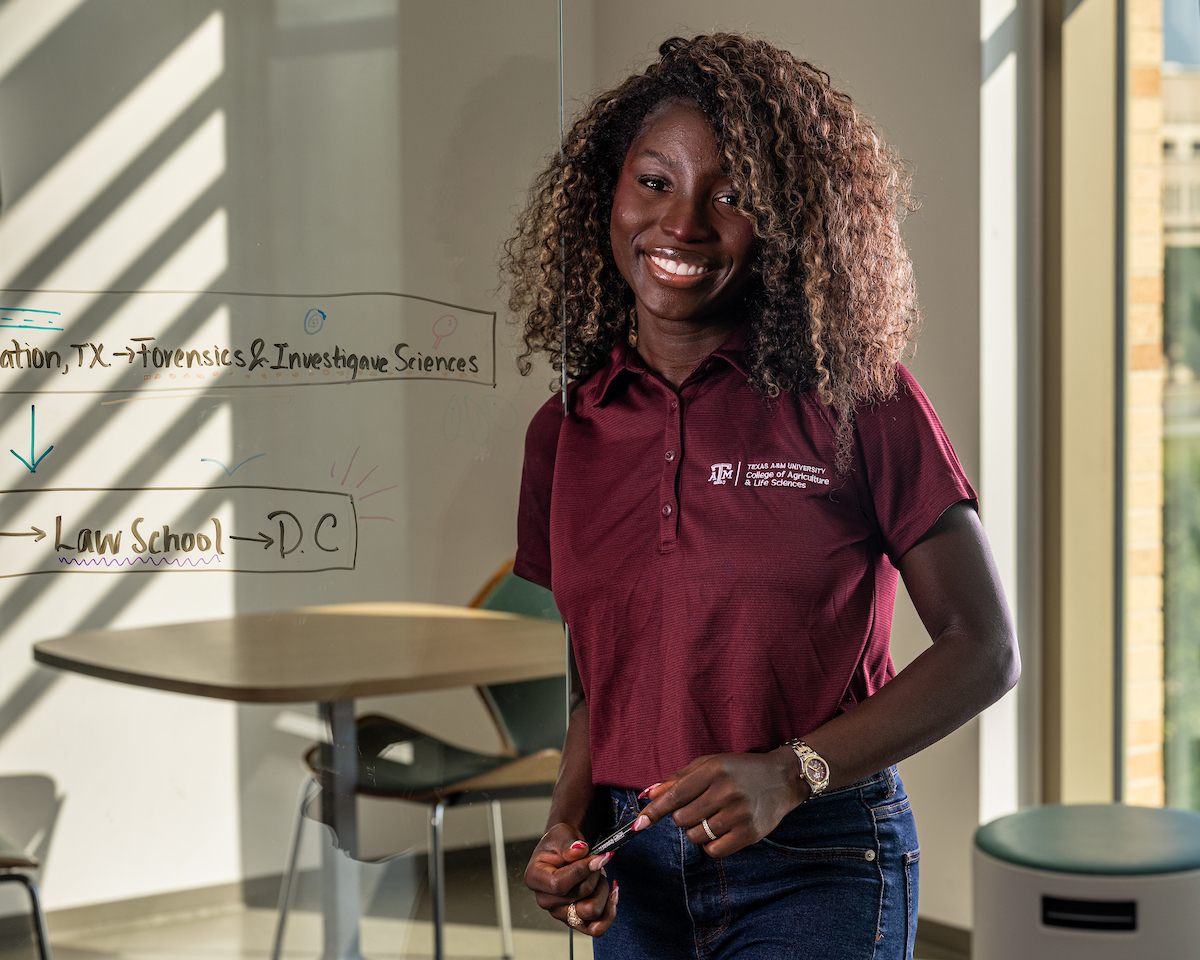
Boluwasefe Adelugba ’26 believes a degree should build more than a good student. As she looks toward law school, she credits Texas A&M with shaping the kind of person she wants to become. (Hannah Lang/Texas A&M AgriLife)
A Trip to Greece Redraws the Map
That something bigger came into focus the summer before her sophomore year, on a study abroad trip to Greece covered by a Benjamin A. Gilman Scholarship. Before that trip, Adelugba admits her picture of agriculture was narrow.
“I pictured plants, cows and vets,” Adelugba said. “Since I’m from Atlanta and didn’t grow up around agriculture, I thought that it wasn’t for me.”
In Greece, Adelugba learned that the country’s weak agricultural standing carried real consequences for its leverage in the European Union, a fragility she saw echoed when her group toured a former oil field scheduled to be closed.
“Watching the connection between Greece’s agriculture and how it impacts their government really showed me how agriculture is part of everything around us,” Adelugba said.
She came home seeing her own college differently: less a single field, more a hub that touches food security, law, business, engineering and policy.
A Bigger Definition of Agriculture
That reframing is what now guides Adelugba as she sets her sights on law school. Eventually, she would like to enter government relations, ideally on behalf of a university or nonprofit whose mission she already believes in. She points to the Texas Legislature’s direct influence on Texas A&M, from budget decisions to campus construction, as the kind of behind-the-scenes work she wants to spend her career doing.
“Supporting policy work that can positively affect people and make their lives better is my dream,” Adelugba said.
It is not the career she imagined at 12 years old, but it grew out of the same instinct to look beyond the surface.
“You can be a good student, but what about being a good person?” Adelugba said. “You’re not going to be a student forever. I think Texas A&M is really good at creating good people.”