

Information below provided by Stephen F. Austin State University Marketing Communications – Phone: (936) 468-2605 – Email: umc@sfasu.edu
NACOGDOCHES, TX – Four Stephen F. Austin State University alumnae returned to campus Sept. 14 to help Nelson Rusche College of Business students prepare for job interviews during “Rusche Ready: Interview Day.”
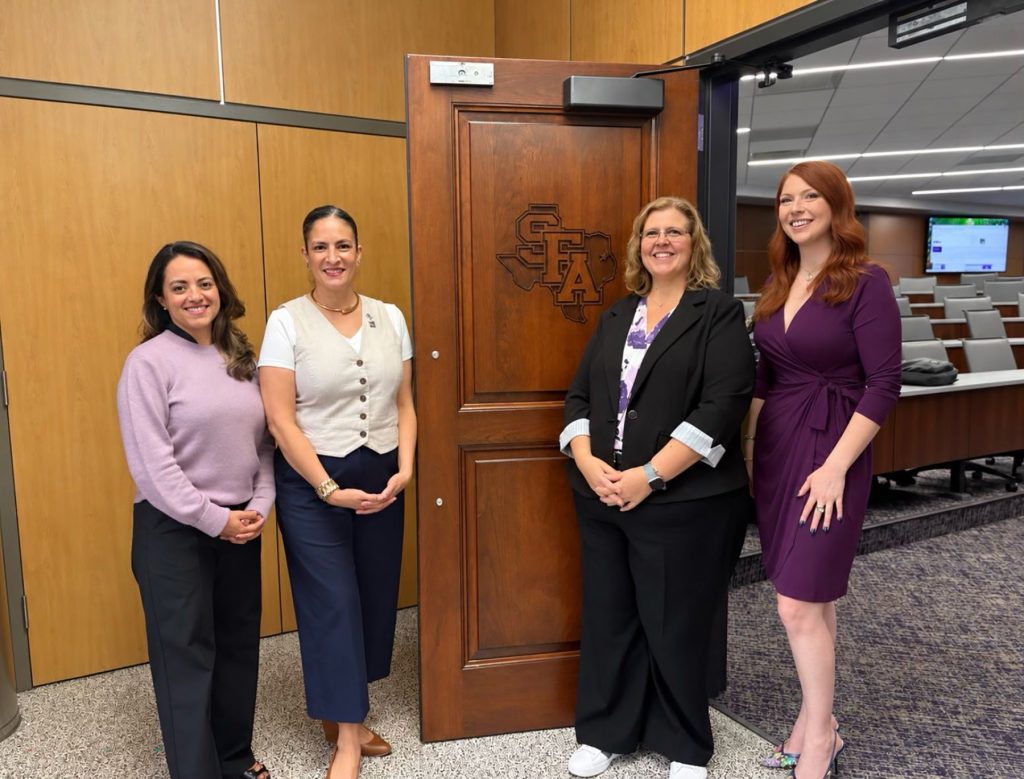
Pictured, from left, are Michelle Gray ’01, vice president and corporate controller at PowerGrid Services; Monica Piña ’01, chief project officer at AE Cruz Construction LLC; Amber Tarol ’01, manager of human resources governance and sustainability at Core Laboratories; and Ashley Partain ’98, global senior human resources manager of people and culture at TechnipFMC.
Hosted by the Schlief School of Accountancy and the Department of Entrepreneurship and Applied Business, the workshop featured Michelle Gray ’01, vice president and corporate controller at PowerGrid Services; Ashley Partain ’98, global senior human resources manager of people and culture at TechnipFMC; Monica Piña ’01, chief project officer at AE Cruz Construction LLC; and Amber Tarol ’01, manager of human resources governance and sustainability at Core Laboratories.
The alumnae shared practical advice on résumés, interviewing, professional communication, workplace attire and networking.
“These four alumnae really knew how to engage the students, from freshmen to seniors,” said Dr. Carol Wright, chair of the Department of Entrepreneurship and Applied Business. “They shared experiences that will give our students a great advantage when interviewing.”
Before students can land an interview, however, they need a compelling résumé, Tarol said.
“Your résumé gets your foot in the door,” she said. “It earns you the interview, not the job itself.”
She encouraged students to create résumés that clearly demonstrate their value to prospective employers. Résumés should be free of typos, use consistent formatting and scannable headings, and highlight accomplishments with strong action verbs. Accomplishments should emphasize results rather than duties by following an action + result + impact formula.
Students also should tailor their résumés to individual job postings by incorporating relevant keywords, Tarol said, noting that artificial intelligence is increasingly used in recruiting.
“Mirror the language of the posting,” she said. “Keywords help recruiters find evidence that you match the job. Make sure the keyword search doesn’t miss you.”
Tarol and Partain also explained the applicant prescreening process, which can include an applicant tracking system that notes a job applicant’s progress through a recruiter review, screening questions and a hiring manager review before an interview invitation is extended.
Partain cautioned students against relying on AI to generate résumés or answer prescreening questions.
“We can quickly identify AI-generated responses,” she said. “Leverage AI for editing and grammar, but recruiters want to hear your voice.”
Once an interview is scheduled, preparation is essential, the alumnae said. Gray recommended practicing in front of a mirror, recording practice interviews or working with peers to identify distracting habits.
Piña advised students to make eye contact, offer a firm handshake, nod to show engagement and speak at a measured pace to make a good first impression.
“You only have about 10 seconds to show how professional and trustworthy you are,” she said.
Professional attire also matters, even during virtual interviews, Gray said.
“You can’t overdress for an interview,” she said. “Even if you know the work environment is casual, hold off wearing jeans and a T-shirt until you get the job.”
Gray also recommended arriving 15 minutes early, researching the company and interviewers, using the STAR method — situation, task, action, result — to answer questions, and preparing questions to ask the interviewer.
The alumnae also stressed the importance of networking.
“Networking starts now,” Piña said. “Establish rapport with your professors, college friends, high school friends and your parents’ friends. Push yourself out of your comfort zone because you never know what opportunity will come.”
Partain and Piña encouraged students to develop a 30-second elevator pitch for networking opportunities, including conferences and trainings, and recommended finding a mentor for guidance, a sponsor to advocate for them and a trusted peer for support.
Partain also reminded students that professional reputations can follow them throughout their careers.
“When you’re networking, your reputation follows you,” she said, using her industry as an example. “Oil and gas is a very small world. You’ll run into people repeatedly, so leave a place better than you found it.”
The alumnae encouraged students to take advantage of SFA’s alumni network as they pursue internships and careers and to use resources like the Business Communication Hub in the Rusche College of Business for résumé reviews and interview practice.
“Lumberjacks really love to give back and pay it forward,” Partain said. “Leverage that network.”
For more information on the Rusche College of Business, visit sfasu.edu/cob.
ABOUT STEPHEN F. AUSTIN STATE UNIVERSITY
Stephen F. Austin State University, the newest member of The University of Texas System, began a century ago as a teachers’ college in Texas’ oldest town, Nacogdoches. Today, it has grown into a regional institution comprising six colleges — business, education, fine arts, forestry and agriculture, liberal and applied arts, and sciences and mathematics. Accredited by the Southern Association of Colleges and Schools, SFA enrolls approximately 11,000 students while providing the academic breadth of a state university with the personalized attention of a private school. The main campus encompasses 421 acres that include 40 academic facilities, 11 residence halls, and 68 acres of recreational trails that wind through its six gardens. The university offers more than 80 bachelor’s degrees, more than 40 master’s degrees and four doctoral degrees covering over 120 areas of study. Learn more at sfasu.edu.